
Young Guns
The foundation years
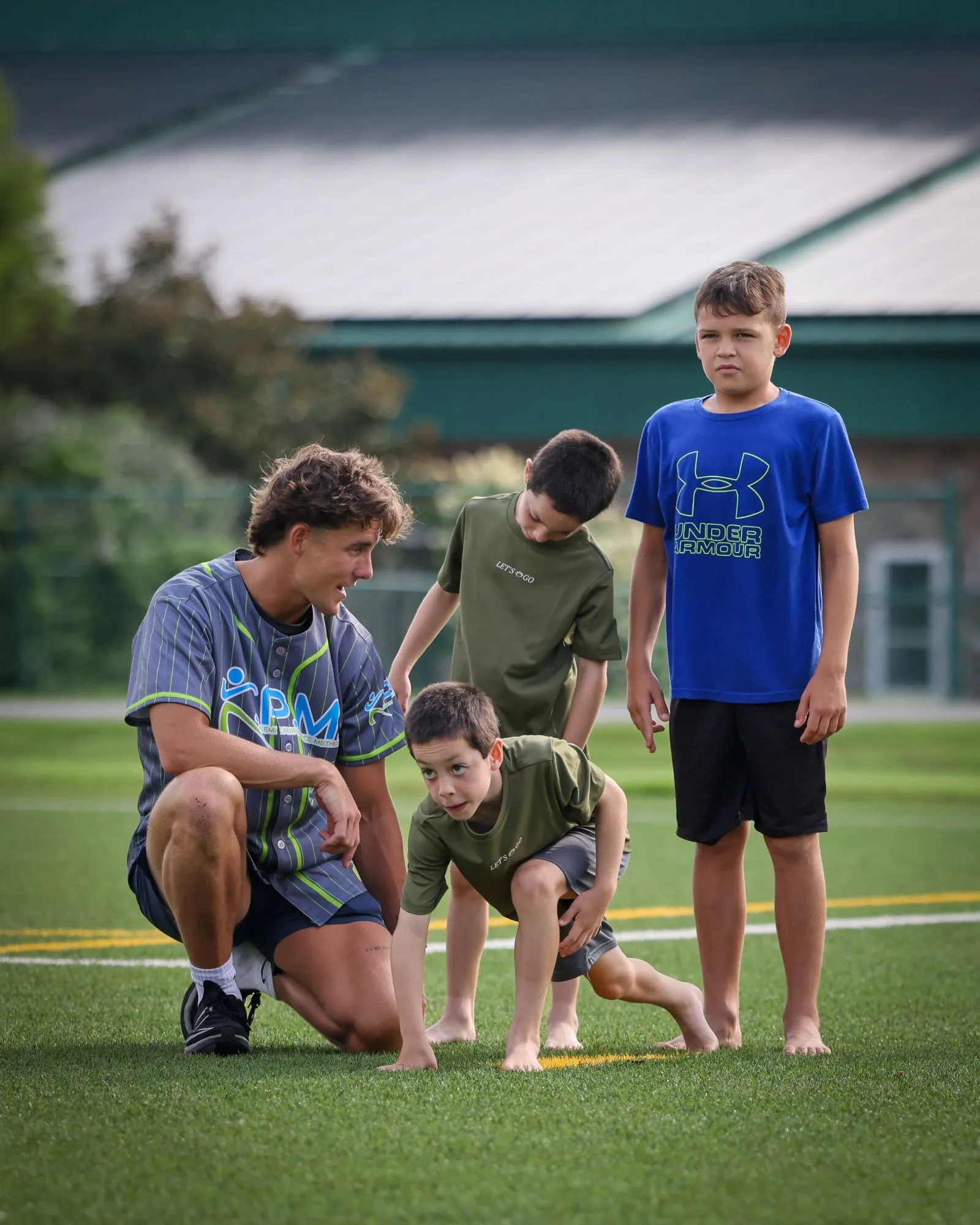
The foundation years — and the ones most programs get wrong twice: first by ignoring them, then by turning them into a shrunken version of high school training. Neither happens here.
Between five and eleven a child's nervous system is learning to coordinate a body that keeps changing size on it. That window is the cheapest athleticism your athlete will ever buy, and it does not come back. So we teach movement, not exercise. How to accelerate. How to stop. How to jump and, far more importantly, how to land. How to be in the air and still know where the ground is.
From the outside it looks like a fast, loud, competitive room full of kids having a great time — which is the only way an eight-year-old learns anything. Underneath it, every game is chosen for a reason and every athlete is on the same four-pillar system a college kid here is on, scaled all the way down.
What it isn't: no barbells. No conditioning for the sake of making a nine-year-old tired. And no specializing in one sport this early — we would rather they play three.
- Warm-up that's really coaching. Posture, foot contacts, arm action — taught while they think they're just warming up.
- One quality per day. Accelerate, or jump and land, or change direction. Never all three at once.
- Games and races that force it. A seven-year-old will not hold a position because you asked. They will hold it to win.
- Finish on a competition. They leave wanting the next one. That's the whole retention plan.
What’s included
- Acceleration and deceleration taught as skills, not drills
- Jumping and landing mechanics before loading anything
- Coordination, balance, and body awareness while they're still growing
- Small groups, age-appropriate loads, a positive and competitive room
- Re-measured at the end of the block, same as every other athlete here
Tuesdays and Thursdays.
Two afternoons a week at KPM, with one optional Saturday morning on the track. Enough to build something at this age, and not so much that a nine-year-old starts dreading it.
- Required Tuesday & Thursday
- Optional Saturday max velocity
-
Mon
No session
-
Tue
Young Guns 3:30 PM at KPM
-
Wed
No session
-
Thu
Young Guns 3:30 PM at KPM
-
Fri
No session
-
Sat
Max Velocity 8:30 AM · 90 min Atlantic Christian Optional
Young Guns train twice a week, Tuesday and Thursday at 3:30 PM at KPM. The Saturday max-velocity session is optional for this age group — 90 minutes at 8:30 AM on the track at Atlantic Christian School, 391 Zion Road, Egg Harbor Township (directions) rather than at 514 New Road. Two days a week is the whole requirement; Saturday is there for the ones who want it.
Athletic Currency
The space an athlete can cover or create — forward and sideways added together, multiplied by how high they get. The bigger it is, the more they make on offense and take away on defense.
At this age the number is not the point — the movement is. But we measure it anyway, from the first session, so that when your athlete is fourteen there is a line going back six years instead of a memory.
How it is measured →one 12-week cycle
went up
band, of 48
least one band
Ages 5–11 train the same four pillars, scaled all the way down. Typical first-cycle figures for healthy high-school athletes training the full twelve weeks, measured on our own gates and mats — the range we see, not a guarantee.
Pick the one that fits.
Every athlete tests in before they train. Which test depends only on whether they have been through a block with us before.
Ready to start?
Book the test, and we will tell you exactly which program fits and what the next twelve weeks look like.
Book a Gait Analysis → Or call — 610-283-4598 →